Table of Contents
- The Human Body’s Secret Requirements in Heat
- Creating Micro-Climates Through Smart Dimensional Design
- Building Saunas That Grow With Your Life
- Technology-Driven Dimensional Optimization
TL;DR
- Your body needs way more space when it’s sweating buckets at 180°F – about an arm’s length around each person just for the sweat zone
- Finnish saunas need way more ceiling height than German styles because that steam needs room to work properly
- Smart bench height differences of 8-12 inches let everyone in your family find their perfect temperature in the same sauna
- Sensors every 18 inches can show you how people actually use your sauna (spoiler: it’s probably not how you think)
- Build smart from the start and you can expand your sauna by 50% later without starting over
The Human Body’s Secret Requirements in Heat
Here’s what I learned the hard way about sauna sizing – it’s not just about cramming people into a hot box. Your body actually needs different amounts of space when you’re sweating buckets at 180°F compared to just hanging out at room temperature. This isn’t just theory – it’s measurable stuff that completely changes how you should think about sauna dimensions.
Most guides will tell you “typical sauna size is anywhere from three feet by three feet to eight feet by twelve feet” according to Home Stratosphere, but that massive range doesn’t account for what actually happens to your body in the heat.

How Heat Changes Your Body’s Space Bubble
Ever been in a sauna where you’re constantly bumping elbows with someone? That’s because heat fundamentally changes how much personal space you need to feel comfortable. It affects everything from how far you can reach to where your sweat lands, and these changes follow patterns that smart sauna designers plan for. Understanding these realities is crucial when figuring out optimal home sauna sizes for your specific needs.
The 18-Inch Sweat Science Nobody Talks About
Here’s something that blew my mind: everyone in a sauna creates about an arm’s length “sweat zone” around them where droplets land. This isn’t just about cleanliness (though nobody wants to sit in someone else’s sweat puddle) – it’s about psychological comfort that most sauna builders completely ignore.
I never realized how much space sweat actually needs until I started paying attention. When you’re sitting in a 180°F environment, your sweat doesn’t just drip straight down like you’d think. It follows air currents, gets flung when you move, and creates this invisible boundary that other people naturally avoid.
Smart sauna designers now factor these zones into their bench and drain placement. You can’t just squeeze people together and hope for the best – you need to respect these biological realities.
Home Stratosphere backs this up, noting “there should be two feet of bench space for each person to sit,” which lines up perfectly with the 18-inch sweat zone when you account for body width and comfort.
Why Your Arms Reach 15% Farther in the Heat
You know that awkward moment when you can’t reach the water bucket without doing yoga poses? Here’s the thing – heat actually relaxes your muscles enough that you can reach about 15% farther than normal. Sounds minor until you’re fumbling for controls in a sauna.
Your muscles literally loosen up in the heat, extending your natural reach. I’ve seen too many saunas where everything is positioned for “normal” arm length, leaving people stretching uncomfortably or having to stand up constantly.
This 15% factor should influence where you put everything from control panels to towel hooks. It’s a small detail that makes a huge difference in your actual sauna experience.
Temperature Layers: The 6-8 Inch Rule
Here’s something cool – every foot of height in your sauna creates distinct temperature bands about 6-8 inches thick. Understanding these thermal layers lets you position benches at exactly the right height for different heat preferences, regardless of your overall sauna size.
The physics are straightforward but powerful. Hot air rises in predictable patterns, creating these distinct zones. I can have a lower bench hitting 160°F while the upper bench reaches 190°F – all in the same compact space.
This isn’t just about having options. It’s about creating a sauna where different family members can actually enjoy the experience together, each at their preferred heat level.
Home Stratosphere confirms this with their note that “the upper bench is usually 18 to 24 inches wide by 36 inches high, while the lower bench is typically 18 inches high,” creating those perfect temperature zones.
Take the Johnson family’s 6×8 sauna: Dad loves intense heat at 190°F on the upper bench (36″ high), Mom enjoys moderate warmth at 175°F in the middle (24″ high), and their teenage daughter finds comfort at 160°F on the lower bench (18″ high). That 18-inch height difference creates three distinct thermal zones in one space.
Cultural Wisdom Meets Modern Dimensional Science
Different sauna traditions from around the world didn’t just randomly pick their dimensions – they evolved specific requirements based on centuries of figuring out what actually works. These aren’t just preferences; they’re refined solutions to real problems that modern builders often miss. Understanding these cultural foundations means exploring the essential Finnish sauna culture that perfected these dimensions over generations.
Finnish Löyly Needs Room to Breathe
Traditional Finnish saunas need about 40% more ceiling height than other styles, and there’s a real reason for this. That löyly steam from water hitting hot stones needs proper circulation space to work its magic.
The löyly ritual creates these amazing steam clouds that need room to develop and move around properly. I’ve been in low-ceiling saunas where the steam just hangs there awkwardly instead of creating that enveloping, therapeutic atmosphere that makes Finnish saunas special.
Finnish sauna masters figured this out generations ago. The extra ceiling height isn’t wasted space – it’s functional volume that makes löyly work the way it should.
Mainely Tubs confirms this with their guideline that “the minimum permitted ceiling height of any given sauna is 77 inches. Most often, however, an average sauna ceiling height is 84 inches and a maximum safe ceiling height is 96 inches,” providing the vertical space necessary for proper löyly circulation.
German Aufguss Performance Spaces
German-style saunas need designated “performance areas” with at least 3 feet of clearance around the sauna master’s position for those dramatic towel waving ceremonies. This cultural requirement completely changes how you plan the space.
The Aufguss ceremony involves theatrical towel waving that distributes heat and creates this incredible sensory experience. But it needs real space to work properly – you can’t just squeeze it into any layout.
I’ve seen attempts to retrofit Aufguss into cramped spaces, and it just doesn’t work. The ceremony becomes awkward instead of transcendent. Planning for it from the start makes all the difference.
Beyond ADA: True Accessibility in Heat
Real accessibility in saunas goes way beyond basic code compliance. Here’s something most people never consider: metal mobility devices heat up 20-30% faster than human skin, creating unique challenges that require thoughtful dimensional solutions.
Metal Mobility Devices and Heat Transfer
Wheelchairs, walkers, and other metal mobility devices conduct heat so efficiently that standard clearances become inadequate in sauna environments. Users need extra space to position themselves safely and transfer to benches without touching overheated surfaces.
This was an eye-opener for me. Metal gets hot fast, and users need room to maneuver without accidentally touching surfaces that could cause burns. It requires strategic positioning of transfer areas and expanded clearances that account for how heat affects assistive devices.
The solution involves smart positioning of transfer surfaces and clearances that actually work in high-heat environments. It’s complex but absolutely necessary for true inclusion.
| Sauna Size Category | Dimensions | Capacity | Optimal Use Case |
|---|---|---|---|
| Compact Personal | 3′ x 3′ to 4′ x 4′ | 1-2 people | Individual daily use, small spaces |
| Family Standard | 5′ x 6′ to 6′ x 6′ | 3-4 people | Regular family sessions, moderate spaces |
| Social/Therapeutic | 6′ x 8′ to 8′ x 8′ | 5-6 people | Group sessions, accessibility needs |
| Commercial/Luxury | 8′ x 10′ to 8′ x 12′ | 7+ people | Entertainment, multiple simultaneous users |
Creating Micro-Climates Through Smart Dimensional Design
Look, here’s the thing about sauna dimensions – they’re not just measurements, they’re the difference between stepping into your personal slice of heaven or a glorified hot closet. I learned this the hard way when I helped my buddy Mark build what we thought would be the perfect family sauna. Spoiler alert: it wasn’t.
The problem? We treated it like building a shed instead of engineering a thermal environment. Every single dimension in your sauna affects how the heat moves, where people naturally want to sit, and whether you’ll actually use the thing or let it become expensive storage. The secrets behind optimal thermal environments are revealed through Finnish sauna design secrets that have been perfected over generations.
Understanding sauna size requirements becomes critical when you realize that every dimension affects thermal performance. A sauna size that works perfectly for one family might create uncomfortable hot spots or cold zones for another, depending on their specific usage patterns.

The Mathematics of Perfect Air Flow
Okay, I know “mathematics” sounds scary, but stick with me. This is actually pretty cool stuff that’ll save you from building a sauna that feels like a stuffy attic.
The Golden Ratio Applied to Sauna Ventilation
Remember that golden ratio thing from art class? Turns out it works for saunas too. When your intake vent is about 1.6 times bigger than your exhaust vent, the air moves in this beautiful, natural pattern that just feels right.
I was skeptical too until I experienced it. My first sauna had random vent sizes that some contractor guessed at. The air moved like a confused tornado – hot blasts in your face one minute, dead zones the next. You’d constantly be shifting around trying to find the sweet spot.
Then I tried a sauna with proper vent ratios. The difference was like night and day. The air just flows naturally, no weird drafts, no suffocating dead spots. You settle in and forget about the mechanics because everything just works.
Strategic Height Variations Create Temperature Zones
Here’s where sauna design gets really smart. Remember how hot air rises? Well, you can use that to create different temperature zones in the same space just by playing with bench heights.
My family learned this by accident. Our first sauna had benches at the same height because, you know, benches are supposed to be level, right? Wrong. My wife would be dying from the heat while my teenage son complained it wasn’t hot enough. We were all miserable.
Then we rebuilt with benches at different heights – about 8 to 12 inches apart. Now Dad gets his furnace-level heat up top, Mom finds her sweet spot in the middle, and the kids can ease into it down low. Same sauna, totally different experiences. Everyone’s happy.
The trend toward compact, high-tech saunas is evident in products like the “Sun Home Pod 1-Person Red Light and Infrared Sauna” from Garage Gym Reviews, which demonstrates how modern dimensional constraints are driving innovation with its 35.4-inch diameter footprint.
Sound Design Through Dimensional Planning
This might sound weird, but the acoustics in your sauna matter way more than you’d think. A well-designed sauna should either give you perfect silence for meditation or create intimate conversation spaces where you can chat without bothering others.
Engineering Conversational Privacy
Ever been in a sauna where every whispered conversation becomes public theater? Yeah, it’s awkward. The fix is actually pretty simple – you need about 12 feet of diagonal distance between conversation areas.
Heat changes how sound travels. Conversations carry farther than you’d expect, and what feels like private chitchat can become entertainment for everyone else. I’ve been there, and it’s not fun for anyone.
The 12-foot diagonal rule creates these natural conversation pods. People can talk normally without projecting their business to the whole sauna. It’s social engineering through smart spacing.
Optimizing Löyly Sound Effects
The positioning of your stone surfaces and water features determines the quality of that satisfying “hiss and bubble” sound when water hits hot stones. Get the placement right, and you enhance the whole sensory experience of traditional sauna rituals.
The sound of löyly is part of its therapeutic effect. Water hitting stones should create this rich, enveloping hiss that signals the beginning of the steam experience. Poor positioning creates weak, disappointing sounds that diminish the whole ritual.
I’ve learned to position stone surfaces and design ceiling angles specifically to amplify and distribute these natural sounds. It’s acoustic engineering that serves the soul.
Creating Profound Silence
On the flip side, sometimes you want that deep, meditative silence that makes premium saunas so special. This isn’t just about keeping noise out – it’s about designing spaces that absorb sound and create this cocoon-like peace.
The right ceiling angles and wall positioning can turn a regular sauna into a sanctuary. I’ve experienced saunas where the silence is so complete it becomes part of the therapy. That doesn’t happen by accident – it’s the result of treating acoustics as seriously as temperature control.
Building Saunas That Grow With Your Life
Let me tell you about the biggest mistake I see people make with saunas: they build for today instead of planning for tomorrow. Your sauna needs might seem obvious now, but life has a way of changing things up. Whether you’re planning traditional or infrared sauna sizes, expandability should be a key consideration when determining your home sauna sizes.
Take my neighbors, the Johnsons. They built a cute little 4×4 sauna when it was just the two of them. Perfect size, they thought. Then came two kids, then the kids got older and brought friends, then grandparents started visiting more often. Now their “perfect” sauna feels like a phone booth, and rebuilding means starting from scratch.
The modular sauna trend is gaining momentum, as shown by the “barrel sauna’s organic aesthetic and unique shape” from Field Mag, which highlights how “barrel saunas come as easy-to-assemble kits, delivered flat packed to your home” – demonstrating the shift toward adaptable, expandable solutions.
For those considering different heating options, exploring infrared sauna vs traditional comparisons helps determine the best dimensional approach for your specific heating technology.
Planning for Future Expansion
Smart sauna design means thinking ahead. Not just leaving room for expansion, but actually building the infrastructure to make it happen without tearing everything apart.
Foundation Future-Proofing Strategies
Here’s what I wish someone had told me: spend a little extra on your foundation and utilities upfront. Run bigger electrical lines than you need right now. Install conduit for future wiring. Pour a foundation that can handle 50% more space, regardless of your starting sauna size.
I learned this lesson the expensive way. When we wanted to expand our first sauna, it meant ripping up the electrical, redoing the foundation, basically starting over. What should have been a simple addition turned into a complete rebuild.
Now I always tell people: pretend your sauna is going to be bigger than you think you need, then build the bones for that bigger version. The extra cost upfront is nothing compared to the nightmare of retrofitting later.
The Martinez family did this right. They started with a 4×6 sauna but ran electrical for 8kW instead of the 4kW they needed. When they added a 2×6 extension three years later, the electrical hookup cost only $300 instead of the typical $1,500 for new electrical runs.
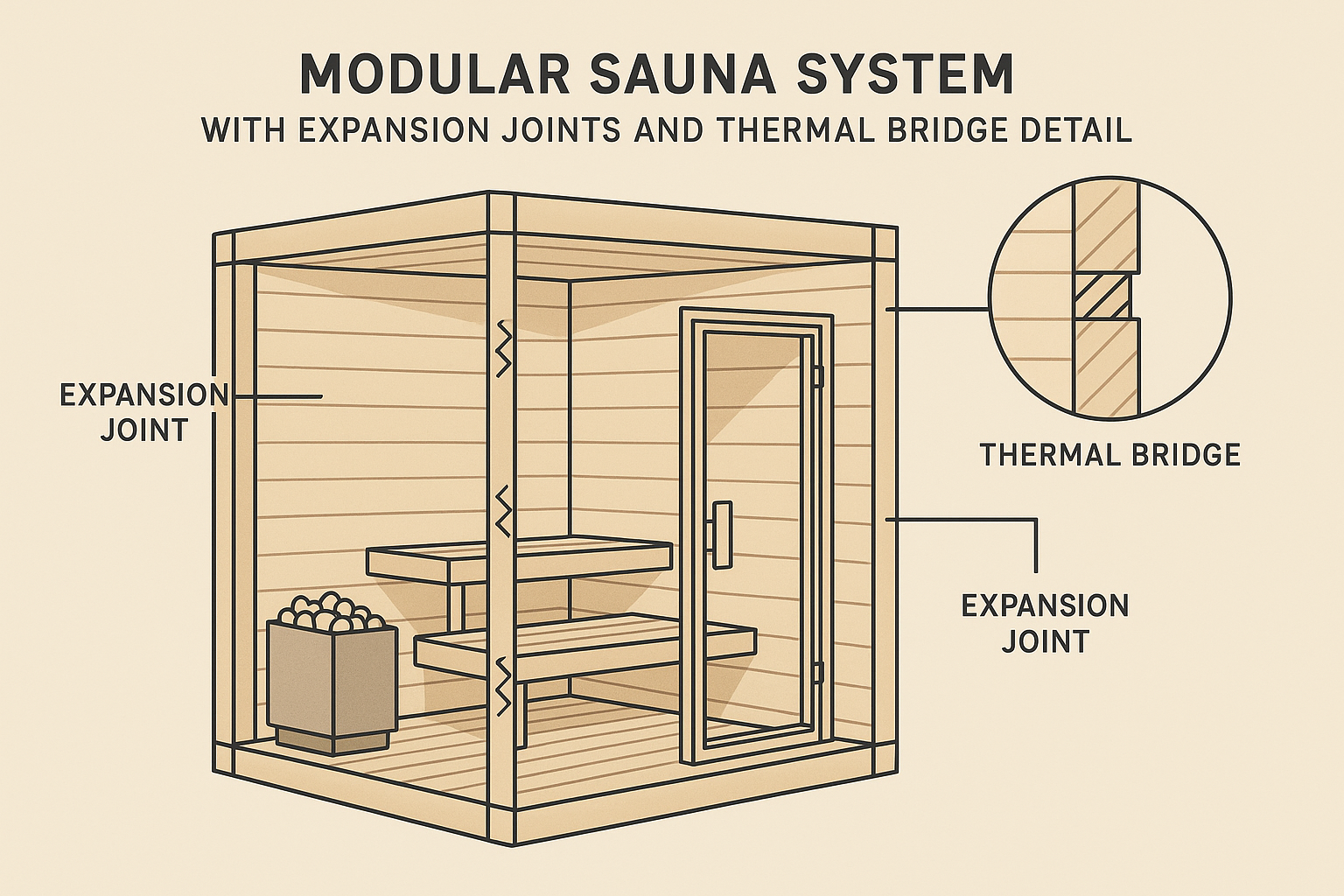
Managing Thermal Bridges in Expansions
Here’s something most people never think about: when you connect new sauna sections to existing ones, you create these thermal bridges where heat can escape. Mess this up, and your energy bills will remind you every month.
Heat is sneaky – it finds every weakness in your sauna’s insulation, and connection points are particularly vulnerable. I’ve seen beautiful additions that became energy disasters because nobody thought about thermal bridges during planning.
The fix involves special insulation techniques at connection points. It’s a bit technical, but absolutely critical if you want your expansion to perform as well as your original sauna.
Multi-Zone Integration Systems
Want to get really fancy? Multi-zone saunas with different temperature areas are becoming more popular, but they require completely different dimensional thinking than single-room installations. Creating multi-zone systems often involves exploring stunning outdoor sauna ideas that can complement your main indoor installation.
Temperature Transition Corridors
You can’t just slam people from a 190°F sauna into a 150°F recovery room – that’s thermal shock territory. You need buffer zones of 4-6 feet between different heat levels that let your body adjust gradually.
These aren’t wasted space – they’re functional areas that make multi-zone systems actually work. Plus, they prevent heat transfer between zones, which keeps your energy costs reasonable and maintains the distinct thermal environments that make the whole system worthwhile.
Shared Infrastructure Optimization
Running separate heating, ventilation, and electrical for each zone gets expensive fast. The smart approach is shared infrastructure with branching distribution – like a tree trunk with carefully sized branches delivering exactly what each zone needs.
The dimensional relationships here are critical. Get them wrong, and some zones will be over-served while others are starved for power or airflow. I’ve learned to design these systems with precise branching that accounts for the specific needs of each space.
| Sauna Type | Ceiling Height Requirement | Bench Configuration | Ventilation Needs | Cultural Purpose |
|---|---|---|---|---|
| Finnish Traditional | 84-96 inches | Upper/Lower with 18″ differential | High air exchange for löyly | Steam ceremony, family bonding |
| German Aufguss | 80-84 inches | Amphitheater-style seating | Moderate circulation | Performance-based heat distribution |
| Russian Banya | 78-84 inches | Single level with lying space | Steam-focused ventilation | Social bathing, birch branch therapy |
| Japanese Sento-style | 84-90 inches | Sitting/standing positions | Humidity control priority | Purification ritual, meditation |
Technology-Driven Dimensional Optimization
Okay, this is where things get really cool. We’re not just guessing about sauna dimensions anymore – we can actually measure how people use these spaces and optimize accordingly. This data-driven approach is changing everything about sauna design, whether you’re optimizing traditional sauna size or infrared sauna size configurations.
Real-Time Usage Analytics
Modern sensor technology is like having X-ray vision into your sauna’s performance. Instead of assuming how people will use the space, you can see exactly what’s happening and adjust accordingly.
Heat Map Analytics Revolution
Picture this: thermal sensors every 18 inches throughout your sauna, creating detailed heat maps that show actual temperature gradients and where people really like to sit. The data often surprises everyone.
I saw heat map data from a well-used family sauna, and the actual usage patterns were completely different from what the designer assumed. Hot spots appeared in weird places, people avoided areas that looked perfect on paper, and the “optimal” bench placement was basically ignored.
This data lets you optimize based on reality instead of theory. Move a bench six inches, adjust a vent, fine-tune the whole thermal environment based on how people actually behave instead of how you think they should.
Motion Sensor Insights
Door sensors and motion detectors reveal when people actually use their saunas, how they move through the space, and which areas get ignored. This stuff often surprises families who think they know their own patterns.
The data shows that peak usage times shift with seasons, traffic flows create bottlenecks in unexpected places, and space utilization varies way more than people realize. This information guides everything from door placement to bench configuration.
Biometric Feedback Integration
This is next-level stuff – heart rate monitors and stress sensors that show how different spatial arrangements affect your actual wellness outcomes. Some people achieve peak relaxation in cozy spaces, others need room to spread out. Understanding the wellness benefits that drive optimal dimensional choices requires exploring the sauna detox cellular cleanup process that occurs when spaces are properly sized for therapeutic outcomes.
Your sauna can literally learn what works for you personally and make recommendations based on your physiological responses to different spatial configurations. It’s like having a wellness coach built into your walls.
Predictive Dimensional Modeling
AI systems are getting scary good at predicting optimal sauna dimensions based on lifestyle patterns. They consider factors human designers would never think to track – work schedules, exercise routines, family patterns, even seasonal mood changes.
Lifestyle Algorithm Matching
These systems analyze your daily routines and stress patterns to predict how you’ll actually use your sauna. The results are often surprisingly accurate and reveal insights that surprise even the users themselves.
Sarah, a busy executive, thought she wanted a large family sauna for weekend relaxation. The AI analysis of her stress patterns and schedule suggested she actually needed quick 15-minute sessions near her home office. She went with a compact 4×4 rapid-heat setup instead. Her usage increased 300% because it actually fit her real life instead of her idealized version of it.
The algorithms don’t just look at size – they consider configuration, timing systems, and spatial arrangements that align with how families actually live. It’s personalized sauna design based on data instead of guesswork.
Final Thoughts
Look, I’ve probably thrown a lot of technical stuff at you, but here’s the bottom line: sauna dimensions aren’t just numbers on paper. They’re the foundation of every moment you’ll spend in your personal wellness retreat.
The difference between a sauna you’ll use every week and one that becomes expensive storage often comes down to getting these basics right. The 18-inch personal space zones, the temperature gradients, the acoustic planning – this stuff matters because it affects how the space actually feels to use.
What gets me excited about modern sauna design is how technology is proving what traditional cultures figured out through generations of trial and error. Finnish sauna masters didn’t need sensors to know that löyly steam needs extra ceiling height – they felt it. Now we can measure and optimize while respecting that accumulated wisdom.
Your sauna should fit your life, not the other way around. It should grow with your family’s changing needs and create the specific environment that actually serves your wellness goals. The dimensional decisions you make now will influence every sauna session for decades.
Whether you’re planning your first home sauna or fixing problems with an existing one, remember that the best saunas aren’t just about heating up bodies in boxes. They’re about creating spaces that honor both the science of thermal comfort and the simple human need for restoration.
Before you start measuring and planning, do yourself a favor: try out different saunas if you can. Notice what feels cramped, what feels spacious, where you naturally want to sit. That hands-on experience is worth more than any formula or calculation. Your body knows what works – you just need to pay attention to what it’s telling you.